
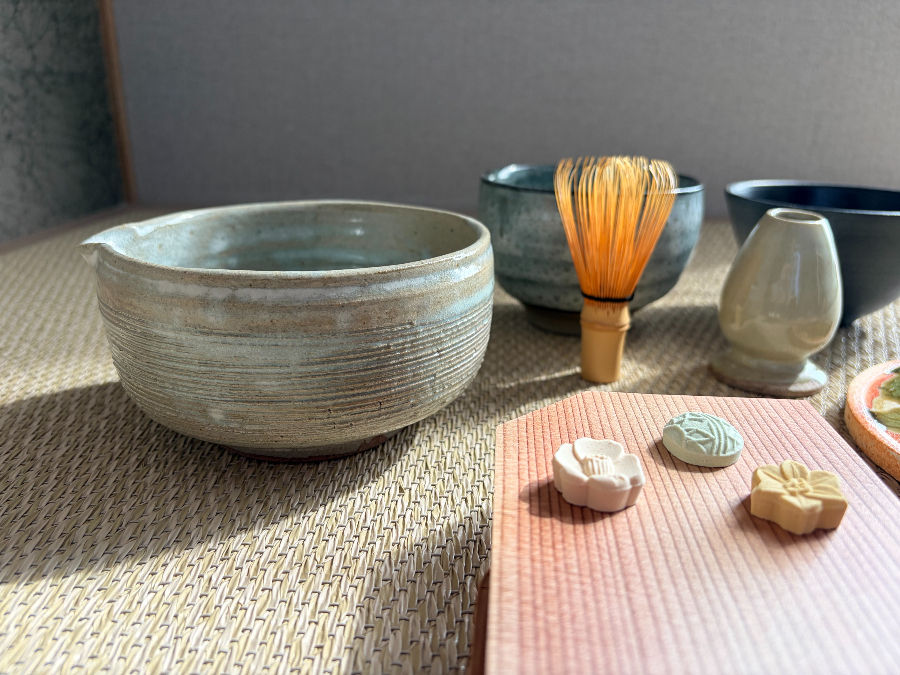

Most people who ask for this bowl call it "the matcha bowl with a spout." In Japan, that spout tells you exactly what it is — a katakuchi, a vessel the Japanese pottery tradition has used for sake and table service for over a thousand years. goenne.livemissioned Master Yasuo Tominaga to make one for matcha: a form the global matcha cafe scene has adopted as its own, made this time by someone who actually understands Japanese tea ceramics from the inside.
Hand-thrown by Tominaga-san. Made exclusively for Goenne Japan.
Kushime & Kiretsu · 櫛目 / 亀裂
The exterior carries two textures working in quiet conversation. Kushime — comb-scoring, a traditional Japanese pottery technique, leaves horizontal lines that circle the lower body of the bowl. Over these, kiretsu: the slight dry-cracking that emerges where the clay was compressed and scraped before firing, leaving fine fissures that the glaze settles into differently than the surrounding surface.
Neither texture is decoration applied after the fact. Both are built into the clay before glazing — which means the final surface is a record of two different kinds of hand-pressure on two different days of making, preserved under the glaze as evidence.
Wara Ash Glaze & Slip · 藁灰釉
The color is unmistakably Karatsu — a cool, muted ash-grey that the tradition has produced from local wood and straw ash for centuries. A white slip applied over the base glaze runs and pools unevenly across the interior and upper rim, catching in the kushime lines, thinning over the raised clay between them. The result shifts between grey, white, and a faint greenish tone depending on the light and the angle.
Tea practitioners call this quality 景色 (keishiki) — scenery. A surface to be read slowly, with attention, each time the bowl is held. It does not announce itself. It rewards the looking.
The Form
What is particular about this piece is how it holds together. The bowl profile is cleaner and more compressed than a traditional Karatsu chawan — lower, rounder, with a quieter silhouette. Against that restraint, the kushime lines and kiretsu texture read as something deliberate rather than incidental. The rugged surface and the composed form are in genuine tension with each other, and that tension is where the interest lives.
Tominaga-san has been working in the Karatsu tradition for over fifty years. The fact that his interpretation of this form reads as both traditional and quietly contemporary is not an accident. It is what five decades of understanding a tradition from the inside makes possible.
Kusenaoshi (tea whisk holder)
A modern development of tea-whisk holder. Unlike majority of the tea whisk holder which are mass-produced by mold. The kusenaoshi whisk holder included in the set is made by the same hands with matching ash glaze.
OUR COMMITMENT
One set at a time. It is how we understand the chawan tradition. Because the day was different, the clay and the kiln behaved differently. When this set is placed, the next commission begins separately. There is currently one set available.
THE POTTERY ARTIST
Yasuo Tominaga · 冨永保雄 · 玄洋窯 Genyou Kiln, Fukuoka
Tominaga-san has worked in the Karatsu ceramic tradition since 1969, trained under Eguchi Sōzan in Karatsu. His work has been selected for the Japan Traditional Kogei Exhibition and recognized across five decades of national and regional exhibition. Associate member, Japan Kogei Association. He has described his career as years spent searching for an encounter between specific soil and himself.
Care instructions on the Product Care page.
MADE in JAPAN
SHIPS from JAPAN
Handmade Katakuchi Spouted Matcha Bowl — Kushime
Stoneware Clay (from Japan)
Glaze: Ash Glaze
